|
Artificial intelligence has quickly moved from an emerging technology to a driving force behind one of the largest waves of private investment Texas has seen in decades. While much of the public conversation has focused on the companies developing AI applications, an equally significant story is unfolding behind the scenes: the race to build the infrastructure that powers it.
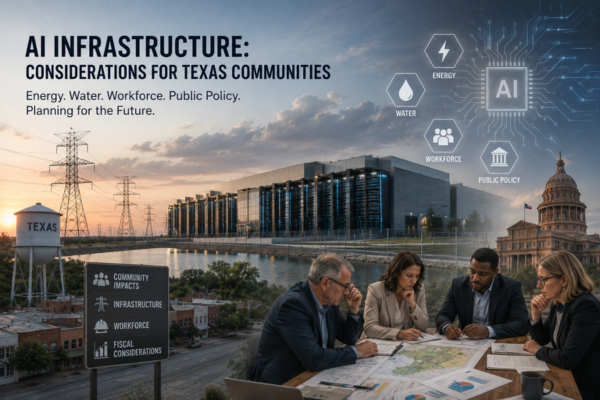
Across Texas, companies are announcing plans for massive data centers capable of supporting artificial intelligence, cloud computing, and advanced data processing. These facilities require billions of dollars in investment, vast amounts of land, reliable power sources, and significant water and telecommunications infrastructure. As Texas continues to attract these projects, school district leaders may begin hearing more about data centers proposed within their communities and wondering what they could mean for public education.
Why Texas?
According to a recent Houston Chronical article examining Texas' emergence as a hub for AI infrastructure, Texas has become an attractive destination for AI infrastructure for several reasons. The state offers abundant energy resources, available land, a favorable business climate, and a growing population. It also has an extensive electric transmission network and access to both natural gas and renewable energy sources.
In a separate Houston Chronicle report, technology companies and energy providers are increasingly partnering to meet the growing energy demands of artificial intelligence. One recent example is Chevron's partnership with Microsoft to develop dedicated natural gas generation to power a large AI data center in the Permian Basin. The project also explores using recycled water for cooling, illustrating how energy, water, and technology are becoming increasingly interconnected.
The scale of these projects is unlike traditional commercial development. Some proposed data centers require electricity measured in gigawatts, levels of demand more commonly associated with large cities than individual business campuses.
More Than an Economic Development Story
For local communities, data centers often represent significant capital investment and the potential for increased taxable property values. For school districts, however, the financial implications are more complex.
A substantial increase in taxable value may strengthen a district's local tax base and affect debt capacity. At the same time, because Texas school finance is designed to equalize funding among districts, increases in property wealth may also influence state aid or recapture, depending on the district's individual circumstances.
As with any major commercial or industrial development, the financial impact will vary from district to district. Understanding how new taxable value interacts with the Texas school finance system will remain an important part of long-range financial planning.
Infrastructure Considerations
The rapid growth of AI infrastructure is also generating discussion beyond school finance.
Data centers require reliable electricity, water, telecommunications infrastructure, and transportation access. As projects continue to expand across Texas, state leaders, utility providers, and local governments are evaluating how to meet those demands while supporting continued economic growth.
According to a report by KTSM, researchers and policy organizations have raised questions about the long-term effects of rapidly expanding data centers on electric demand, water resources, and public infrastructure. Industry leaders, meanwhile, continue to emphasize the economic opportunities these facilities can bring to local communities.
As additional projects are announced, many communities may find themselves balancing economic development opportunities with infrastructure planning and resource management.
A Growing Workforce Opportunity
The rapid expansion of AI infrastructure is also drawing attention to Texas' future workforce needs.
While large-scale data centers generally employ fewer permanent workers than many traditional manufacturing facilities, they require a highly skilled workforce in areas such as electrical systems, industrial maintenance, networking, cybersecurity, HVAC, automation, engineering, and information technology. As AI infrastructure and other advanced industries continue to grow, demand for these technical skills is expected to increase.
In a recent article, the Dallas Express reported that Gov. Greg Abbott directed several state agencies to strengthen workforce development initiatives and expand training opportunities for high-paying skilled trade careers. Although the directive extends beyond AI infrastructure, it reflects a broader effort to prepare Texans for careers supporting the state's growing economy.
For school districts, these trends underscore the continued importance of Career and Technical Education (CTE) programs and partnerships with higher education institutions and local employers as students prepare for careers in increasingly technical fields.
The Legislature Is Paying Attention
As investment in AI infrastructure accelerates, the issue has also attracted attention at the state level.
According to a recent article in The Texas Tribune, legislative leaders have directed committees to study several issues related to data center expansion, including electric grid reliability, water use, infrastructure needs, and the state's tax policies affecting data center development.
In a related article published The Texas Tribune, Lawmakers are reviewing the state's sales tax exemption for qualifying data centers. According to the article, Texas is projected to lose out on $3.2 billion in sales tax revenue over the next two years as a result of an exemption. Supporters argue the incentive has helped Texas attract significant private investment, while others have questioned the long-term fiscal impact as the number and size of projects continue to grow.
Those discussions illustrate how rapidly AI infrastructure has moved from an emerging industry to a significant public policy topic.
Looking Ahead
Artificial intelligence is reshaping more than the technology sector. It is influencing economic development, energy production, infrastructure planning, workforce needs, and public policy across Texas.
For school districts, the long-term effects will likely differ from one community to another. Some districts may experience new commercial development and changes in taxable value. Others may benefit from workforce partnerships or regional economic growth. Communities may also encounter new discussions surrounding infrastructure, utilities, and long-range planning.
Although many questions remain, one thing is becoming increasingly clear: the expansion of AI infrastructure is no longer simply a technology story. It is a Texas story, one that school leaders may find increasingly relevant as communities across the state continue to grow and evolve.
|